

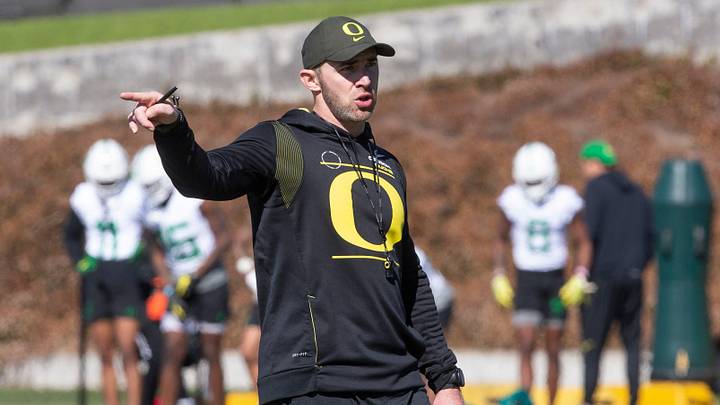
Drew Mehringer last called plays ten years ago at Rutgers, and the results weren't very good. The Scarlet Knights scored just 15.7 points a game that season, ranking 127th out of 128 teams in NCAA Division I football.
In conference play the scoreboard proved even more unbalanced, with Mehringer's squad held to 9.9 points per game, shut out four times. A three-star from Warren, Michigan, quarterback Giovanni Resigno completed 52.8 percent of his passes for 889 yards. He threw just five touchdowns in seven games with five interceptions.
The team went 0-9 in conference. On October 8, 2016 against No. 4 Michigan the Wolverine defense held Mehringer's crew to 39 total yards of offense and two first downs. They went three-and-out 14 times, 0-17 on third down and lost 78-0.
The track record creates some anxiety about Mehringer's readiness to drive one of college football's most talented rosters on offense, a five-star quarterback throwing to three five-star wide receivers with two explosive running backs and the best pass-catching tight end in college football.
Anxious fans should ask themselves, "Are you better at your job than you were ten years ago?"
A journey marked by failing spectacularly, followed by ten years of paying dues
Mehringer's grown since the debacle in Piscataway. He's 38 now and he's coached at Texas, Florida Atlantic and New Mexico, been on the staff at Oregon since Dan Lanning took over as head coach in 2022.
He feels coaching tight ends over the last few seasons has given him a unique perspective. He told podcast host, Duck alum and NFL veteran George Wrighster, "There's not a lot skill coaches who spend any time around the offensive line. There's not a lot of offensive line coaches that have spent much time around skill. Being the tight ends coach you get a little bit of both, a lot of both."
Mehringer has learned to think about players as well as plays. It's their abilities and limitations that drive the success of the offense.
"I think that a lot of what people get focused on is scheme, scheme, scheme. How do I call this play. What do we run this into? You lose the concept of what you're asking your left tackle to do."
In a similar way, he's developing a trusting, collaborative relationship with quarterback Dante Moore. Moore's leadership and growth is the number one key to Oregon's success in 2026. "Now our relationship is a lot different," Mehringer said, "But because he's so mature you can have NFL-like conversations with him."
"I can sit down with him and say, 'here is the 25 plays that we like. I need you to help me get this down to 16.'"
When Dante Moore has confidence and an understanding of a concept, he can be lethal throwing the football.
Dante Moore Cut Ups https://t.co/KqvIclPEXO pic.twitter.com/H5uuJn0R7p
— jeremiah🐦⬛ (@NewEraMiah) May 30, 2026
Last season the Ducks were effective in the scripted portions of a game, but struggled to make adjustments when things weren't working, when opponents threw something new at them or applied pressure in unexpected ways.
Mehringer's "What can our players do? What are they most confident in?" approach should help him in applying in-game solutions. He's not wedded to a predictable set of responses. With the new OC calling plays for both sides, the Combat Ducks and Fighting Ducks didn't throw a single wide receiver screen in the Spring Game. Dylan Raiola, Akili Smith Jr. and Brock Thomas all completed deep shots.
The offense can sustain success if Mehringer trusts the talent at his disposal, lets Dante Moore cook. The expectations are enormous, but they have to remember something Dan Lanning says all the time: Pressure is a privilege.
Top 10 college football QBs with the most to prove pic.twitter.com/zI1xPrE9bW
— Kalshi Football (@KalshiFB) May 30, 2026
 Add us as a preferred source on Google